Building the AI Super Brain: Edge Computing for Physical AI Robots

How Aetina and NVIDIA® Jetson Thor™ Enable Production-Ready Humanoid Robots


The robotics revolution is evolving from basic automation toward high-level intelligence. Humanoid robots are transitioning from laboratory novelties into practical assets for manufacturing, logistics, healthcare, and service industries.


Overview: From Embodiment to Physical Realization

The world is ready for humanoid robots. Logistics and manufacturing face serious labor shortages, while healthcare professionals are overstretched due to aging populations and staffing issues. However, achieving reliable real-world deployment remains a formidable engineering feat. This transformation centers on two core pillars:

    1. Embodied AI: Creating a physical "body" for AI to form a continuous sense-think-act closed loop.
    2. Physical AI: Enabling systems to understand, reason, and execute complex tasks within unpredictable real-world environments.

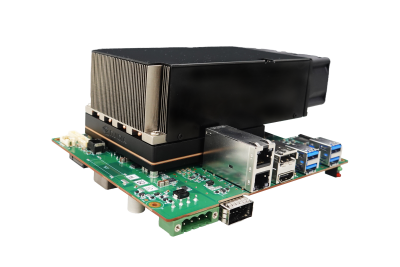
As an NVIDIA Elite Partner, Aetina provides the AIB-AT78/68 supercomputing platform—the "AI Super Brain" powered by NVIDIA Jetson Thor—to handle demanding edge workloads and accelerate autonomous mobility. Aetina recognizes that the success of these machines depends on a robust computational foundation, allowing humanoid robots to perceive, reason, and act with human-like precision.


The Challenge: The Sim-to-Real Struggle

Despite promising demand, OEMs and System Integrators struggle to translate humanoid prototypes into deployable systems that operate in real-world environments. Through collaborative projects with leading developers in Germany and South Korea, Aetina identified several critical pain points:

  • Computational Bottlenecks

    Humanoid robots must simultaneously manage complex motion and multimodal AI reasoning. They must integrate perception, cognition, decision-making, and motion control in real-time. Traditional x86-based IPCs proved inadequate, as they lacked the unified memory architecture and tensor-core density to run multimodal models like Vision-Language-Action (VLA) alongside real-time motor control.

  • Sensor Data Saturation and Integration Issues

    In unstructured environments like warehouses, humanoid robots may need to process up to 15 GMSL camera feeds, multiple LiDAR streams, and radar data simultaneously to make split-second decisions. Managing these synchronized streams for 360-degree vision causes critical system lag. Many edge modules lack the bandwidth and connectivity required for such high data throughput.

  • AI Engineering Challenges

    Unpredictable factors like shifting lighting and floor textures cause AI misjudgments. Systems require "physics-aware" reasoning to navigate complex scenarios. Consequently, intricate software engineering tasks increase development difficulty, cost, and time-to-market.


Aetina's Strategic Engineering Partnership: Two Case Studies


Aetina recently deployed solutions with two leading robotic development companies. One company in South Korea aimed to build general-purpose humanoids for safety-focused facilities, while a second in Germany focused on humanoids for factory warehouse logistics.

Both teams required a powerful platform capable of autonomous decision-making and multimodal AI inference. Integration was a mutual pain point: the Korean team needed their computing platform to work synergistically with a separate mechanical control platform, while the German team struggled with integrating stereo GMSL camera data.

Aetina helped both teams through a comprehensive four-part approach:

 
  • Deploying the NVIDIA Jetson Thor-powered AI Super Brain (AIB-AT78/68)

    Powered by NVIDIA Jetson Thor modules, the AIB-AT78/68 is purpose-built for physical AI. Based on the NVIDIA Blackwell GPU architecture, the NVIDIA Jetson T5000™ delivers up to 2070 FP4 TFLOPS of AI inference performance. This provides up to 7.5x higher AI compute and 3.5x better energy efficiency compared to NVIDIA Jetson AGX Orin™, enabling real-time synergy between decision-making and mechanical control.

  • GMSL2 Sensor Integration and BSP Customization

    Aetina helped the German client build 360-degree 3D vision system by integrating the 120-pin MIPI with a GMSL2 adapter board, supporting 8x GMSL2 cameras via the customized Board Support Package (BSP). This ensured high-fidelity spatial perception and full visual awareness.

  • High-Speed I/O for Dexterous Motion

    The AIB-AT68/78 1x QSFP28 slot (4x25GbE) port provided high-speed connectivity to support the NVIDIA Holoscan Sensor Bridge. Combined with dual 10GbE LAN and one 1GbE EtherCAT ports, this created a high-performance robotic “nervous system” capable of achieving 41+ degrees of freedom (DoF). This ensures zero-latency transmission to precision end-actuator for human-like dexterity and balance.

  • Leveraging the NVIDIA Ecosystem

    As an NVIDIA Elite Partner for Jetson Thor, Aetina provides ready-to-ship software based on the NVIDIA JetPack™ 7.

    1. NVIDIA JetPack SDK: Provides a comprehensive, well-documented framework for accelerated AI software engineering.
    2. NVIDIA Holoscan Sensor Bridge: Enables high-throughput, low-latency sensor fusion for perception.
    3. NVIDIA Isaac GR00T & Isaac™ Lab: Provides AI foundation models for cognition and control while accelerating sim-to-real transfer through simulation and training environment.


Aetina's Key Advantages:

Aetina's AIB-AT78 and AIB-AT68 platforms are deployment-ready, not mere evaluation boards. They offer unmatched inference capabilities, a strong power-performance balance, and a compact form factor.

Partnership Benefits: Developers get insider help integrating and optimizing system components by working Aetina that receives early access to technology, like Aetina. We assist by:

    1. Fine-tuning the NVIDIA JetPack 7 for specific requirements.
    2. Delivering tailored BSPs ported to NVIDIA JetPack via firmware engineers experienced in low-level driver development.
    3. Offering integration assistance for complex external peripherals and sensors.
 

Aetina AIB-AT68/78 Technical Specifications

Specification Details
Platform Platform NVIDIA Jetson T5000™ / T4000™
GPU Architecture NVIDIA Blackwell
AI Performance Up to 2070 FP4 TFLOPS (7.5x vs. NVIDIA Jetson AGX Orin)
Energy Efficiency 3.5x better efficiency vs. NVIDIA Jetson AGX Orin
High-Speed Connectivity 1x QSFP28 (4x25Gbps) for NVIDIA Holoscan
Network I/O 2x 10 GbE LAN, 1x 1 Gb EtherCAT
Camera Interface 120-pin MIPI (supports 8x GMSL2 cameras)


Future Outlook

Humanoid robots have long been hampered by insufficient compute and complex sensor integration. Today, robust hardware like NVIDIA Jetson Thor and support from specialists like Aetina are overcoming these pain points. Practical, scalable embodied AI is closer than most realize. Driven by strategic partnerships, humanoid robots are finally on the way to real-world deployment.

To learn more about Aetina's AIB-AT68/78 platforms, BSP customization services, or to discuss bringing a physical AI project to market, contact our expertise team or visit www.aetina.com


Back
close

Top
ALERT TITLE
Ok
/html>